Texas Biomed and the Southwest National Primate research Center celebrated the new Health Center with staff, architects, construction teams, community members, board members, donors and public officials with two special events in the spring.
SNPRC is one of seven federally designated centers funded in part by the National Institutes of Health (NIH) that are leaders in ethical and humane biomedical research with nonhuman primates. Primates are the gold standard research model for humans because they share more than 90% of our DNA. They’re critical in making sure that medicines, vaccines and technologies are safe and effective before they’re allowed to move into human-based clinical trials.
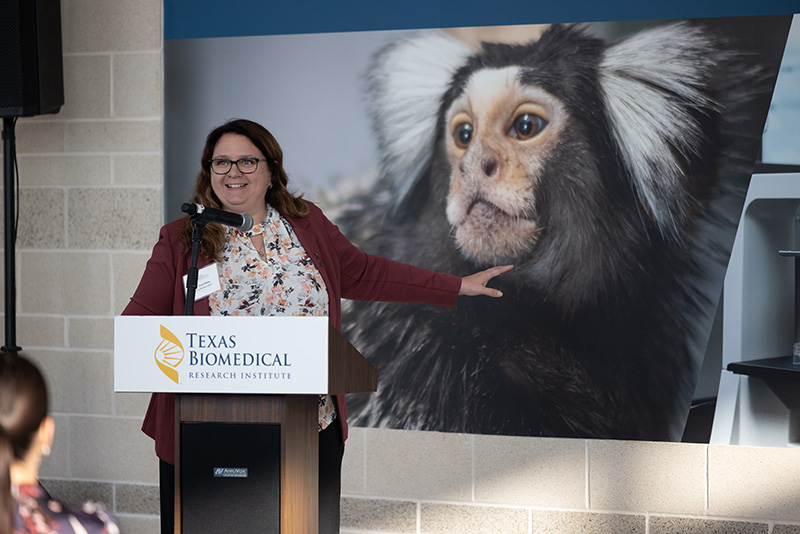
“This new center provides access to the latest technologies helping us answer some of the biggest questions in human health, including infectious diseases, obesity, aging and neurodegenerative conditions like Alzheimer’s and Parkinson’s disease,” said SNPRC Director Corinna Ross, Ph.D. “We are excited to move into a space that not only advances our research capabilities but also reflects our deep commitment to exceptional animal care and the remarkable people who make this work possible every day.”
SNPRC’s team of more than 150 scientists, veterinarians, animal care specialists, pathologists and behavioral scientists help care for more than 2,500 baboons, macaques and marmosets. As a national resource, SNPRC supports scientists across the U.S. to conduct research with primate models that can lead to lifesaving discoveries.

Global demand for infectious and chronic disease research continues to grow, which makes Texas Biomed’s unique combination of high-containment labs alongside the SNPRC a national asset, said State Rep. Josey Garcia, who represents the district, at the ribbon cutting ceremony.
“Facilities like this are essential to ensuring the United States remains at the forefront of research and biosecurity,” she said.
San Antonio Mayor Gina Ortiz Jones underscored how Texas Biomed is vital for protecting both global and community health.
“The Institute’s level of precision, safety and expertise in studying some of the world’s most dangerous pathogens has put our city on the map as a world leader in infectious disease research,” she said.








The Health Center mural aims to capture the spirit, breadth and depth of the Institute since its founding in 1941, and the impact that every person and animal has on human health. Learn more: bit.ly/snprcmural