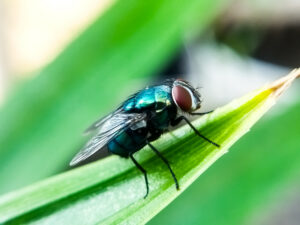
Texas Biomed partners with Flyttr to combat New World screwworm

After being eliminated from the U.S. for nearly 60 years, the New World screwworm is back and threatening Texas’ multibillion-dollar agricultural economy. Texas Biomed is partnering with biotechnology company Flyttr to combat the parasitic fly, which lays eggs in fresh wounds, causing serious infection in livestock, wildlife and, in rare cases, humans. Over the next two years, Flyttr will use advanced laboratory facilities at Texas Biomed to accelerate research and development of suppression technologies designed to stop the pest’s spread. “We are very pleased to support Flyttr as it develops innovative approaches that could help protect producers and communities in Texas and beyond,” said Cory Hallam, Ph.D., Executive Vice President of Applied Science and Innovation at Texas Biomed. The partnership not only brings advanced biotechnology to San Antonio, it helps strengthen the region’s position as a leader in biosecurity innovation and One Health research to protect people, animals and the environment.

TB and HIV treatments are not enough for a full recovery

Even after individuals have been successfully treated for HIV and tuberculosis (TB), the immune system does not fully return to normal. Rather, it stays in an overactivated, inflammatory state with impaired functionality, which could explain why people living with HIV remain more susceptible to TB reinfection and other illnesses. “The good news is that the treatments control the virus and kill most of the TB bacteria,” said Assistant Professor Riti Sharan, Ph.D., who led the work with Professor Deepak Kaushal, Ph.D. “The bad news is that the immune system in the lungs does not fully recover.” The findings, made in nonhuman primate models of TB and HIV coinfection, underscore the need to develop immunotherapies that help the immune system recover. With more than 2 billion people estimated to have dormant or latent TB, including up to 13 million in the U.S., the potential benefit is huge. The study was published in Nature Communications.

Low-dose THC reduces side effects of HIV treatment

Antiretroviral therapy (ART) is very good at suppressing HIV to undetectable levels, but as people live longer with HIV, they are experiencing chronic inflammation and substantial side effects that can lead to cardiovascular, liver and neurological diseases. Professor Mahesh Mohan, D.V.M., Ph.D., and his lab are exploring long-term, low doses of THC, the main active compound in cannabis, as a way to minimize harmful side effects. The dose is so low there are no overt nervous system effects such as a euphoric “high.” In preclinical studies with animal models representing people with HIV on ART, the team observed many benefits, including increased production of the chemical serotonin and reduced systemic inflammation. Cholesterol levels and harmful secondary bile acids decreased. Levels of ART drugs, which can be toxic to the liver over time, were also lower in blood plasma without affecting viral suppression. “There were no downsides,” said Staff Scientist Lakmini Premadasa, Ph.D. “I kept looking because I couldn’t believe it could all be good, but I really could not find any negative impacts.” The findings were published in Science Advances.
Texas Biomed testing potential first measles treatment

The measles vaccine, introduced in 1963, has been so effective at suppressing the virus that no treatments have been required and measles has been considered eliminated in the U.S. since 2000. That’s changing with the drop in childhood vaccination rates and spike in infections across the nation. Texas Biomed’s Applied Science and Innovation team is partnering with the La Jolla Institute for Immunology to test what could become the first antiviral treatment for the highly contagious disease. The monoclonal antibody showed promising results in cell and rodent studies and is now being evaluated in nonhuman primates at Texas Biomed’s Southwest National Primate Research Center. If these preclinical studies show the treatment is safe and effective, it could proceed to human clinical trials. “This could become an excellent tool to treat measles once a person is infected, but it will be several years before it is potentially available,” said Assistant Professor Viraj Kulkarni, Ph.D. “The best way to prevent infection and protect kids, who are the most vulnerable group to this disease – now – is the vaccine.”