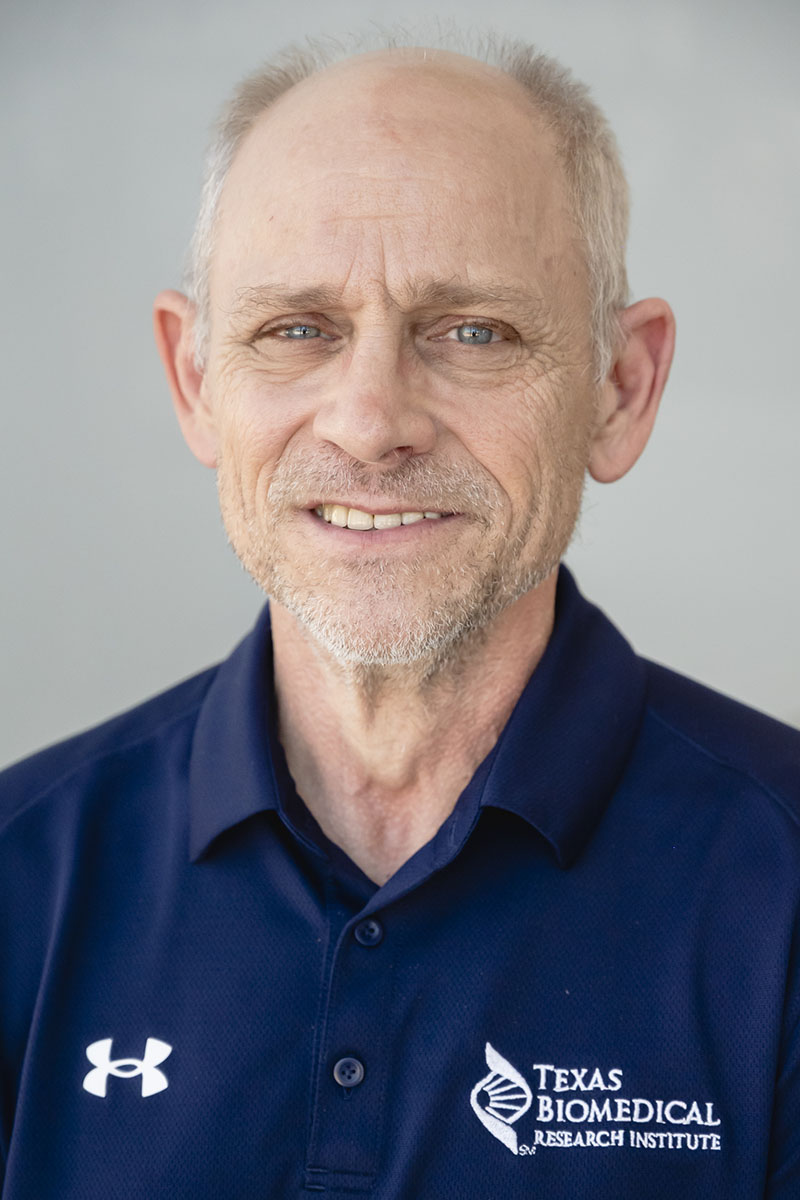
After 45 years of service, Terry Hawkins retired from his “home away from home.”
He simply needed a job.
Freshly graduated from high school, Terry Hawkins was considering joining the Coast Guard to earn money for college when a friend told him about an open animal caretaker role at Texas Biomed. The friend advised that he could easily grow into more technical roles if he wanted. So in 1979, Hawkins began feeding nonhuman primates, washing down their enclosures and learning about the scientific research on campus.
Opportunity for career growth was an understatement for Hawkins, who retired in 2026 as Director of Software Architecture & Development and Primate Records Database. Over 45 years, he progressed from caretaker to vet tech to computer programmer, veterinary services supervisor, interim IT director and systems administrator, among several other IT titles.
“To be honest with you, one of my favorite jobs I’ve had here was an animal caretaker,” he said. “I got to work outside, fresh air every day, and I really enjoyed working with the animals. Every animal that I worked with, I could look at them and knew who the animal was.”
Hawkins briefly left the organization in 1988 when funding dried up before being recruited back a year later. Having always had an interest in electronics and already writing code to support research studies, he went on to study computer programming at The University of Texas at San Antonio while working full time. As the world moved into the computing era, he combined his unique expertise in both animal care and programming to help modernize how the Institute tracks animal health.
“Not being the smartest person in the room, but working with the smartest person in the room – that has probably been the most rewarding,”
Terry Hawkins
In the early 1990s, he wrote the very first program to record clinical data at the Institute, capturing vital metrics like age, sex, weight, blood pressure and so on. “We did everything on paper up until that point,” he said. Others had built separate programs for specific needs such as recording diet.
“The teams working with the animals said ‘We need better tracking of the animals. We need more history, more accurate data, more timely data,’” Hawkins said. “So the head of IT and I sat down and designed what we wanted the system to look like.”
Working with both internal and external colleagues, Hawkins developed the comprehensive software systems and databases still in use today that track everything from daily animal observations, health exams and procedures to genetic history, research studies and pathology.
Over the decades, he worked with many of the Institute’s top scientists, veterinarians, colony managers, caretakers and vet techs – ultimately helping to make animal care, management and research smoother, more traceable and robust. Critically, the systems he helped write ensured that the same type of information was coded the same way across the board, seamlessly unlocking the wealth of data generated by the Institute and Southwest National Primate Research Center.
“Having these electronic tools has made animal care and management so much more efficient and powerful,” said Sharon Price, the baboon colony manager who has been with Texas Biomed for nearly 30 years. “We can record metrics in very fine detail that can be accessed across the Institute and even by other primate centers. This helps us do our best for the animals, while also maximizing the information we are learning from them to advance animal and human health.”
When the Institute moved to a third-party platform used by other primate centers for similar purposes, Hawkins collaborated with those developers to customize the system and ensure it provided the same functionality and powerful features. Now, whenever a staff member records a data point in the internal system called CAMP, within an hour it has updated in the external system known as Total Animal Care.
“I like making systems that are totally different talk to each other,” he said. “I like working with data models. I like mining data. I like data analysis. You know, typical data nerd.”
But he’s much more than that. Curious about many things, he gets bored easily and so having a variety of jobs at Texas Biomed suited him well. A tinkerer and designer, Hawkins enjoys building and refurbishing watches – a skill he picked up after being sorely disappointed with a shoddy repair job on a prized Swiss dive watch he’s had since he was 17. He’ll work on watches more in retirement now, along with spending time with his family and five grandkids.
When asked to describe Texas Biomed in a word, he didn’t hesitate: “home away from home.” While the Institute has evolved dramatically over four decades, the one constant has been working with great people to improve global health.
“Not being the smartest person in the room, but working with the smartest person in the room – that has probably been the most rewarding,” he said.
He now hands the reins over to the team he has helped mentor and is confident the Institute’s data and systems are in capable hands, especially as the AI era begins to shape the future of the next 45 years.