IMPACT
Texas Biomed marks
25 years
of safe, maximum containment
research
Texas Biomed marks 25 years of safe, maximum containment research
Since 2000, Texas Biomed has been at the forefront of studying deadly pathogens and testing vaccines and treatments against them, including anthrax and Ebola virus. Today, the Institute is an internationally recognized partner in defending the nation and world from potential biological threats.
No one had done it before. Built a maximum containment laboratory, that is, outside of the federal government or the military in the United States.
In the mid-1990s, Texas Biomed set out to build a biosafety level 4 (BSL-4) lab, which represents the highest level in biocontainment and provides a safe space to study infectious diseases that can spread in the air and have no vaccines or cures.
“It was more or less ‘keep it simple, stupid,’” recalled Professor Emeritus Jean Patterson, Ph.D., who helped lead the project. “That meant we didn’t over engineer it. We didn’t have a lot of bells and whistles. That has served us well through the years.”
While it may sound counterintuitive, simplicity in this case means safer. Every critical system, from the air locked doors to air filtration, wastewater treatment, power and the like, all have redundant, backup systems. Being more streamlined meant there were fewer things to break and incorporating redundancy was more efficient.
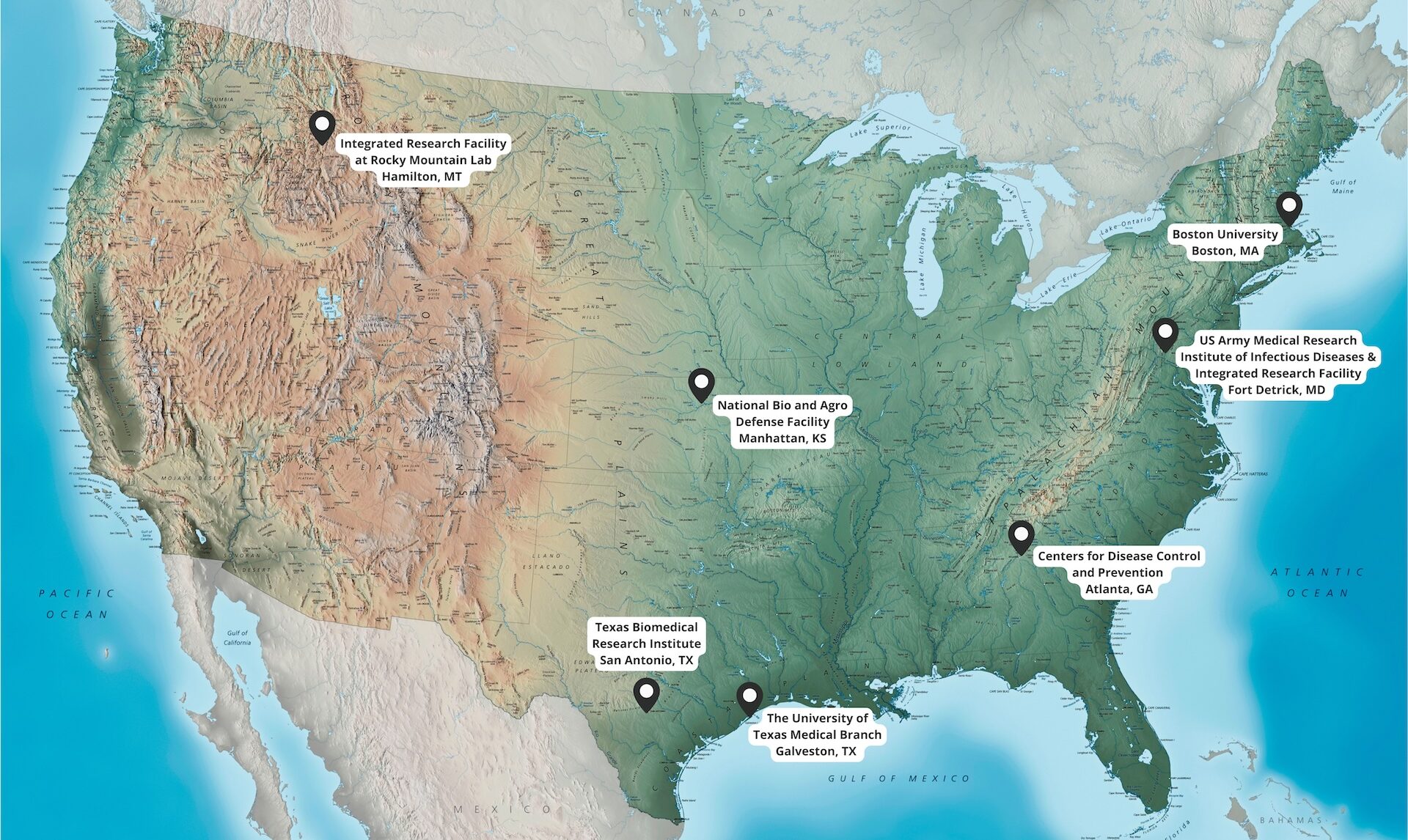
When the lab “went hot” in the spring of 2000, it was the first BSL-4 west of the Mississippi and only one – still – privately owned and operated by a nonprofit research institute in the U.S.
Biosafety Levels
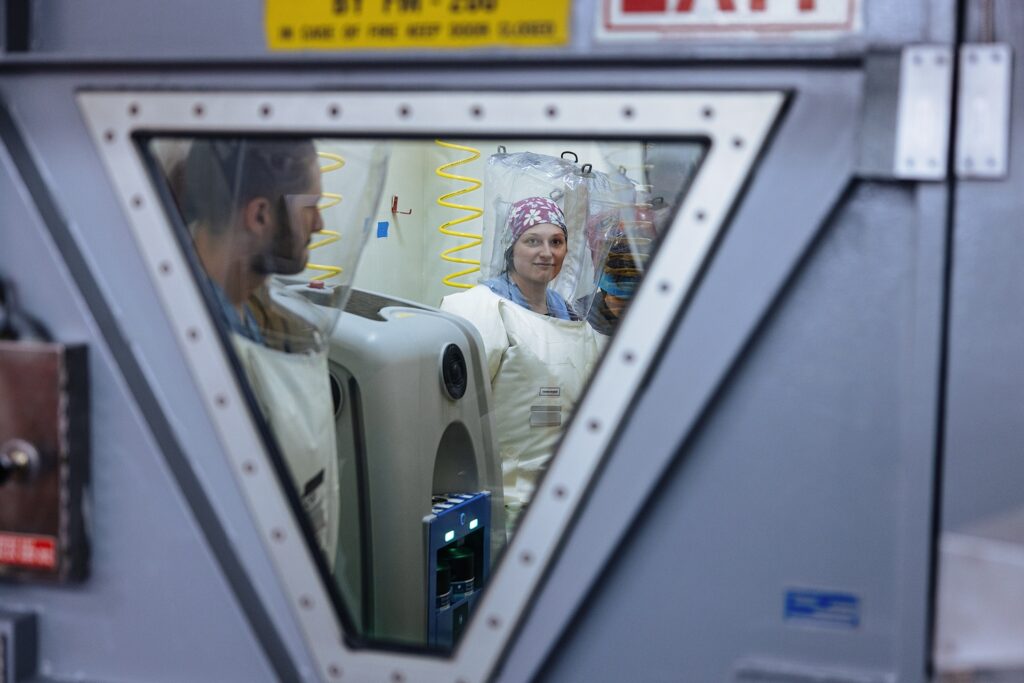
Biosafety levels range from 1 to 4 and are based on the required facilities, protocols and personal protective equipment (PPE). A typical lab is considered a BSL-2, while BSL-3 and BSL-4 have increasing levels of protection.
Over the past 25 years, Texas Biomed has been at the forefront of safely studying some of the world’s deadliest pathogens and developing vaccines and treatments to protect against them – all thanks to having the specialized facilities along with the scientific and engineering expertise to do so. Today, the government, industry and global organizations are partnering with Texas Biomed on national security, pandemic preparedness and the development of medical countermeasures.
“Texas Biomed is being increasingly recognized as an essential part of the nation’s defense infrastructure to prepare for future threats,” said President/CEO Larry Schlesinger, M.D. “As an independent nonprofit, we can pivot quickly to respond during a global health emergency. As we mark 25 years of accomplishments, we are looking to the future and how we meet the growing needs projected over the next 25 years and beyond.”
Critical infrastructure
Texas Biomed’s established track record in high containment research has led to several significant national and global partnerships for pandemic preparedness in the last few years, including with the Department of Health and Human Services’ Center for the Biomedical Advanced Research and Development Authority (BARDA), the National Institutes of Health, the Department of Defense, the international Coalition for Epidemic Preparedness Innovations (CEPI) and many commercial partners.
Each of these entail conducting highly regulated preclinical studies to prove a vaccine or medicine is safe and effective in animal models before proceeding to people. This is especially vital for lethal diseases where traditional clinical trials in people are impossible. For such pathogens, the FDA’s “Animal Rule” allows well-characterized animal models to be used in place of human efficacy trials to support regulatory approval of vaccines or therapies.

“Biodefense is of critical importance to our country. These partnerships are evidence of the high quality, specialized work we can deliver,” said Cory Hallam, Ph.D., Executive Vice President, Applied Science and Innovation at Texas Biomed. “It is a testament to the excellent Texas Biomed team and their deep expertise – which includes everyone who works in the lab and outside the lab to design, document and deliver these groundbreaking studies.”
The BSL-4 lab is not large. It can typically accommodate one study a month and has been booked solid for years. That is why Texas Biomed is working to expand its high containment facilities to serve growing demand in combatting national security threats, including bioterrorism and infectious diseases. The Institute expects the expanded lab space, which will triple capacity, to come online in 2028.
This will further position Texas Biomed as a leading private sector partner in conducting fundamental research into these pathogens, while helping to increase the arsenal of potential medical countermeasures against them.
From Anthrax to Ebola to COVID
Some of the earliest studies in the BSL-4 were focused on anthrax. In the wake of 9/11, letters laced with the toxic bacteria began showing up in the U.S. mail. Texas Biomed assisted the government in running tests seeking to identify the origin of the pathogen as part of the Amerithrax investigation. Technically, anthrax can be safely handled in BSL-3 labs because a vaccine and antitoxins exist, but at the time, the BSL-4 provided the safe space needed to accommodate the volume of work.

Following the anthrax attacks, federal funding for infectious disease research – especially into bugs that could potentially be used as biological weapons – dramatically increased. Put bluntly, Dr. Patterson said: “Without anthrax, we wouldn’t have an Ebola vaccine.”
Texas Biomed researchers helped test the world’s first Ebola virus vaccines and treatments developed by industry partners inside the BSL-4, establishing that they were effective at protecting against infection and curing the disease.
Some of the tests occurred as the world’s largest Ebola virus outbreak was spreading in West Africa, between 2014 and 2016. In total, more than 28,000 people were infected and more than 11,000 died. It also marked the first cases of Ebola virus in the U.S., when a man was diagnosed while visiting family in Dallas, Texas, and subsequently two hospital nurses became infected.

“This was a very challenging time,” said Professor Ricardo Carrion, Jr., Ph.D., who has helped oversee many of the Ebola vaccine and antibody studies at Texas Biomed. “It was clear that the Ebola virus wasn’t going to be confined to Africa, it was clear it was lethal and we did not have a vaccine or therapy against it. The government had us evaluate many of their top candidates for Ebola virus in our animal models that we developed here.”
Ebola’s fatality rate has run as high as 90% in some outbreaks. It is spread from animals to humans, and then through contact with infected fluids, surfaces and materials. It can take two to 21 days from infection to develop symptoms, which can at first appear like malaria, typhoid fever or meningitis. This means the virus can be unintentionally spread and presents a global threat no matter where it begins.
Texas Biomed also collaborated closely with Janssen, now part of Johnson & Johnson, on its Ebola Zaire virus vaccine for the better part of 15 years. The vaccine was deployed during the 2018-2020 Ebola outbreak in the Democratic Republic of Congo and was approved in the European Union in 2020. Similarly, the team worked with Regeneron to evaluate its antibody cocktail against Ebola Zaire virus, which became the first Ebola treatment approved by the U.S. FDA in 2020.
More recently, the team has collaborated with Sabin Vaccine Institute and Mapp Biopharmaceutical, Inc. to evaluate vaccines and treatments for closely related viruses that are also extremely lethal: Sudan ebolavirus and Marburg virus. The Sudan ebolavirus vaccine and antibody therapy were deployed to Uganda in 2022 during an outbreak there, and the Marburg vaccine, which is in Phase 2 clinical trials, was deployed to Rwanda during an outbreak in 2024.
“We are proud to have played a role in the studies needed to advance these vaccines and therapies to human trials and to help protect people in outbreaks,” Dr. Carrion said.
Other success stories to have come through the lab: the Pfizer-BioNTech and Novavax COVID-19 vaccines and Regeneron’s COVID-19 antibody therapy. The Texas Biomed team ran some of the preclinical studies in the BSL-4, not because it required that level of biosafety, but because at the height of the pandemic, there were severe personal protective equipment (PPE) shortages and the BSL-4 full-body “space suits” are reusable.
“That was a big moment for all of us, when those vaccines were approved,” Dr. Carrion said. “We knew we had been working on something that could help protect people around the world and our families at home.”
What’s it like to work in a BSL-4?
Dr. Carrion was a graduate student when he first began working in the BSL-4. He remembers holding a vial containing Ebola virus for the first time.
“I remember thinking, ‘This is amazing. It takes just one viral particle to cause an infection and this one vial contains millions, billions of particles.’ And then, I just got to work,” he said. “You know you are safe because of your biosafety suit and the way the lab is designed.”
What makes a lab a BSL-4, as compared to a standard BSL-2 or specialized BSL-3, are the extensive safety protocols and procedures, the protective equipment researchers wear and the specially designed physical support infrastructure.
A lot has to do with air flow.
The lab itself has negative airflow, meaning air does not flow out of the room, but in. This ensures any particle in the air cannot leave the double air-locked doors and move into the hallway. The researchers work with pathogens under vented hoods, called biosafety cabinets, that also pull air in, further minimizing any potential spread from accidental spills or splashes.


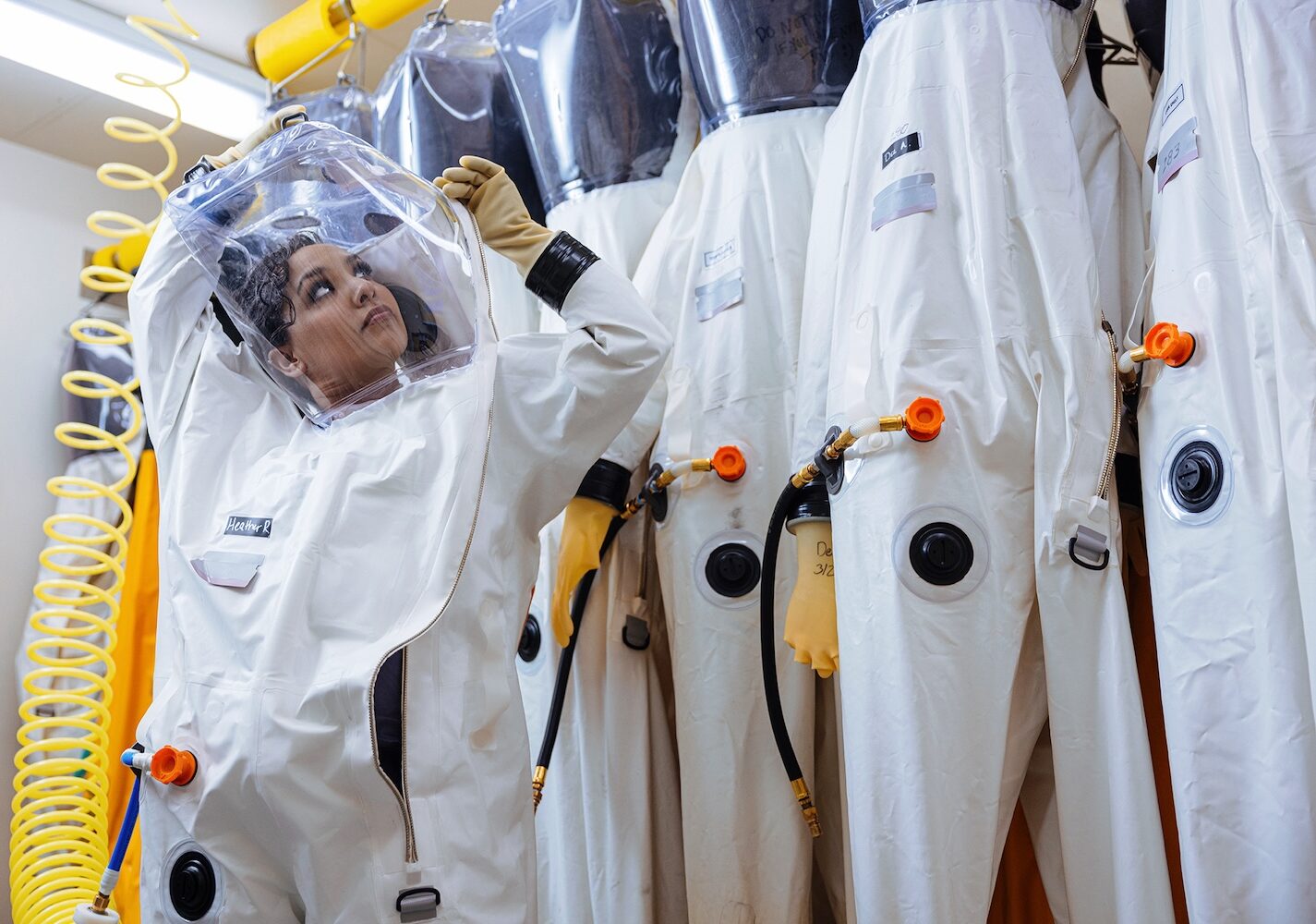
Researchers wear scrubs and full body suits, reminiscent of space suits, that are connected to hoses pumping in fresh HEPA-filtered air. This air allows the researchers to breathe easy and maintain positive pressure, so that if there was a hole in the suit, the person is still protected because the air is pushing everything out of the suit. Researchers also wear at least three sets of gloves, including thicker built-in suit gloves that are connected to hard cuffs, sealed with O-rings and further secured by wide tape. Upon exit, they take a 7-minute chemical decontamination shower in the suit. Scrubs are autoclaved at such high heat and steam, it kills or deactivates anything on them, before being laundered. Researchers must then take a regular shower lasting at least 5 minutes before donning their street clothes.
“Working in the 4 is like being a passenger on a long plane flight, but with no water and no snacks,” Dr. Carrion explained. “Because it is such a process, you plan to be in there for several hours. You go in a little dehydrated and think hard about what to eat – or not eat – beforehand because it is at least 12 minutes before you will get to a bathroom if you need one.”
Culture of safety
The Institute has a robust training and mentoring program to ensure team members are well prepared for the physical and mental load of working inside the BSL-4. It is physically demanding, with 10-pound suits and pressured air weighing them down. Every task takes longer in this environment. And the work requires 100% focus – each person is responsible not just for their own safety but those around them.
“Everyone is encouraged that if they don’t feel well or maybe have something going on at home – there is nothing wrong with saying they don’t feel up for going in the BSL-4 lab that day,” said Hsiang-Ming (Anthony) Wang, Ph.D., Environmental Health and Safety Director. “This culture of trust and support is essential to avoiding accidents and keeping everyone safe.”

The team also routinely runs drills for different scenarios, such as a potential exposure or having a medical emergency while inside the lab. For a potential exposure, the Institute’s emergency response plan would be activated immediately. As the researchers exit the lab following standard disinfection procedures, an Infectious Disease Medical Response Team would be assembled, including representatives from local, state and federal health departments, to determine the monitoring, quarantine and treatment procedures. In the immediate aftermath of an accidental exposure, there would be no opportunity for others to be exposed thanks to the swift isolation protocols and because it takes more time for a virus to replicate to the point of being infectious.
“The safety record in North America is excellent. There has never been a serious illness to spread from a BSL-4 in the U.S. or Canada,” Dr. Patterson said. “Nothing is 100% safe – all these labs will tell you that. But it is statistically more dangerous to drive on the 410 freeway than it is to work in the lab.”
The safety culture doesn’t stop with the researchers. It also includes a team of highly trained engineers and technicians who maintain the specialized lab infrastructure and its critical systems. Every year, the lab “goes cold” – meaning there are no pathogens inside – for several weeks for regular maintenance, equipment upgrades and trainings, further reinforcing the high safety standards.
“The engineering team provides the foundation that physically supports the researchers in the lab and ensures everyone can operate in arguably the safest research environment there is,” Dr. Schlesinger said.
Leading discovery and innovation
In addition to helping partners, Texas Biomed scientists are also seeking to better understand deadly pathogens through fundamental research. They are particularly interested in emerging threats that are known to be lethal but are otherwise largely a mystery. One example is Nipah virus, which is found naturally in bats throughout Asia, parts of Africa and Australia, and has caused numerous outbreaks since it was first identified in 1998. The outbreaks are typically quickly contained but have an estimated fatality rate of 40-75%.
“When people talk about what could cause the next pandemic, many epidemiologists and virologists will put their money on Nipah virus,” said Assistant Professor Olena Shtanko, Ph.D.
Dr. Shtanko is working with colleagues at Southwest Research Institute to use artificial intelligence to screen for potential compounds that might work to neutralize Nipah and other viruses, which can then be tested inside the BSL-4 lab. This in vitro work is conducted primarily in cells in plastic dishes.
Other teams are working to screen antivirals against Hendra virus, Lassa virus and Crimean-Congo hemorrhagic virus – all pathogens that the World Health Organization has designated as a top priority because they have the potential to cause pandemics and no vaccines or treatments exist.

They are also working to design new vaccines and therapies. For example, Professor Luis Martinez-Sobrido, Ph.D., is working on a vaccine against Lassa virus. (Read more here.)
Any vaccine or therapy is first studied in cells and then in small animals, before being evaluated in nonhuman primates. In some cases, rodents cannot be used. For example, Ebola virus does not cause mice to get sick, making it difficult to evaluate if a vaccine or therapy will work. Nonhuman primates, as the closest relative to humans, are the gold standard for understanding how an entire immune system will react to a new vaccine or therapy.
Texas Biomed, as the home to the Southwest National Primate Research Center, is a leader in nonhuman primate research as well as virology and immunology. Texas Biomed scientists have helped establish national protocols for testing vaccines and therapies in nonhuman primates, to ensure that no matter which facility conducts the tests, the results will be the same and can be trusted.
“We appreciate that San Antonio, as Military City USA and a city of science, understands the importance of this work and has been a longstanding supporter of the Institute,” Dr. Schlesinger said. “Only if we are able to study these threats in a secure environment can we develop lifesaving tools and have a chance at getting ahead of what nature, or our adversaries, have to throw at us.”