With more active construction on campus at one time than ever before, Texas Biomed is well on its way to realizing its modern vision.
As Texas Biomed celebrates its 85th anniversary, significant changes are happening all over campus to ensure the Institute is prepared to take on the challenges of the next 85 years.
“This is an exciting period of transformation for the Institute,” said Matt Majors, Texas Biomed Vice President of Operations. “We have more than $200 million of construction projects underway to upgrade critical infrastructure, build resiliency and expand our research capacity.”
This spring, Texas Biomed and Southwest National Primate Research Center celebrated the opening of the new Health Center. The 18,000-square-foot building houses next-generation veterinary suites, pathology and histology labs, as well as modern spaces for animal care staff. It is the central anchor of the larger Animal Care Complex, which includes three new state-of-the-art housing facilities — two opened in late 2023 and the third will be completed this year — that feature large outdoor areas with play structures and indoor areas that can be kept cool or warm depending on the season.
“Opening the Health Center is a significant milestone as we continue to modernize our campus and meet the needs of our staff, researchers and partners in government and industry,” said Larry Schlesinger, M.D., Texas Biomed President/CEO. “These facilities are enabling the cutting-edge science to help us improve human health and raise the bar for the health and well-being of our precious animals.”
Enhanced security and resiliency
Another key focus over the past two years has been undergrounding all power lines and significantly upgrading electrical and fiber internet infrastructure. This includes establishing a microgrid, which is a self-contained system that can generate and distribute power to the entire campus when normal power is lost.
“As massive new data centers, semiconductor and other large-scale projects launch across the state, sufficient, reliable power for our mission-critical scientific research will become more important than ever,” Majors said. “We are very excited to bring the microgrid online. This adds a whole new level of safety and reliability to our operations.”
The microgrid will connect to the Texas ERCOT power grid via CPS Energy, enabling the Institute to sell power when not needed. In an emergency, the microgrid operates independently, supplying power to the campus.
Critical upgrades have also been completed on the water systems that underpin Texas Biomed and SNPRC operations. The water and electrical infrastructure improvements have been enabled by $13.5 million in federal American Rescue Plan Act funds provided by the City of San Antonio and Bexar County.
Also completed in the past year: a new perimeter security fence compliant with the needs of Texas Biomed’s federal partners, and the new Shipping, Receiving and Maintenance building. The high-traffic hub is now positioned immediately off Military Drive with its own dedicated entrance for delivery vehicles coming and going daily, improving efficiency and security.
BSL-4 expansion underway
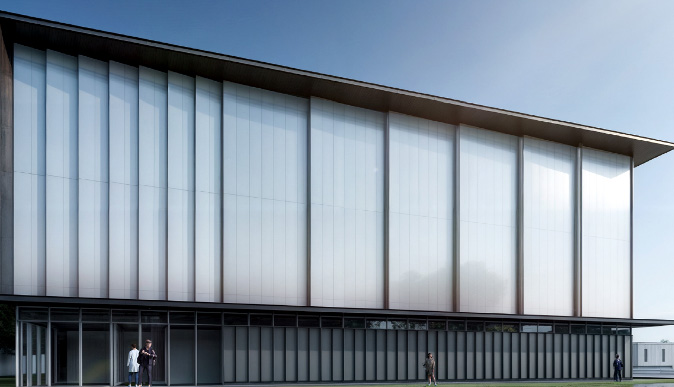
The Institute broke ground in late 2025 on a new biosafety level 4 (BSL-4) laboratory. The $83 million facility will triple the Institute’s capacity for studying pathogens that require the highest level of biocontainment safety protocols, such as Ebola virus and other deadly agents.
“We are leveraging our decades of experience in maximum containment research to help improve the nation’s biodefense infrastructure,” said Cory Hallam, Ph.D., Executive Vice President of Applied Science and Innovation. “This will enable us and our partners to accelerate development of vaccines and therapeutics needed to combat emerging and reemerging threats that currently have no cures.”
Texas Biomed has operated the only privately owned BSL-4 in the country since 1999. The new lab is slated for completion in late 2028 and will offer next-generation scientific capabilities.
“The nation’s needs for this type of facility are increasing significantly,” Dr. Schlesinger said. “But just as important as the lab itself is the track record to move safely and quickly. Texas Biomed’s deep expertise, nimbleness and speed are all major advantages as we respond to urgent crises and work to get ahead of biological risks to keep people safe.”
Along with the latest technologies, the new building will incorporate architectural features that pay homage to Institute founder Tom Slick Jr. and a method he co-developed and patented in 1948 for more efficient concrete work, called lift slab construction.
“The exterior design will subtly honor the innovative spirit of our founder that continues strong to this day inside our laboratories, while we equip the Institute for the future of infectious disease research,” Majors said.