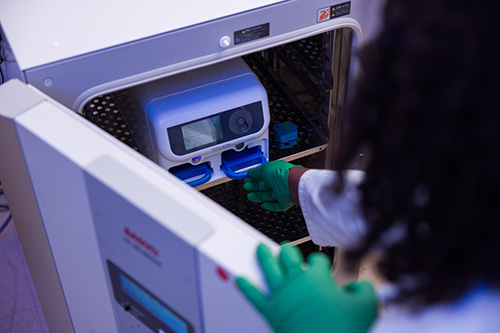
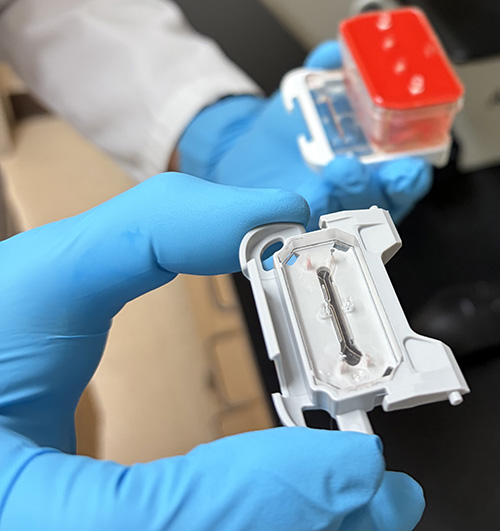
The new fund has enabled Texas Biomed to acquire advanced imaging technology for spatial biology studies. Annu Devi, Ph.D., demonstrates how the Akoya PhenoCycler Fusion reveals not only what molecules are present in a tissue sample, but where they are located and how they interact with neighboring cells.
Texas Biomed has established a $2 million Tuberculosis Innovation and Technology Fund supported by an anonymous donor investment to accelerate future TB discoveries, therapies and cures.
Tuberculosis (TB) is the world’s deadliest infectious disease, causing more than 1 million deaths globally each year. The new fund supports recruitment and retention of top scientific talent in a highly competitive field and the purchase of next-generation research technologies.
“This fund allows us to strengthen our scientific capabilities that our researchers and partners can leverage as we work together to identify more effective TB vaccines and treatments for millions of people around the world and here in Texas,” said Larry Schlesinger, M.D., Texas Biomed President/CEO.
TB is often thought of as an illness of the past, but remains a significant health concern in Texas, which consistently reports some of the highest numbers of TB cases in the country. In 2024, Texas recorded 1,270 cases of TB, a 16% increase since 2022.
With the new funding, Texas Biomed has acquired the Akoya PhenoCycler Fusion system and the Emulate Orb and Zoë Culture Module system, which are advanced imaging and organ-on-a-chip technologies, respectively. These new approach methodologies (NAMs) will facilitate understanding of cell-to-cell interactions, map tissue architecture, clarify disease progression and infection mechanisms, and enable faster development of vaccines and therapies – at a magnitude not previously available in the region.
The TB fund was enabled by a significant contribution to The Catalysts Initiative, a program launched by Texas Biomed to help address funding gaps that have traditionally been covered by federal research grants.
“We are grateful for our community’s commitment to scientific innovation and improving global health,” said Sara Wise, Texas Biomed’s Vice President of Development. “This support doesn’t just fund research — it is opening up a new era of discovery.”
Texas Biomed is a leader in the TB field, hosting one of the nation’s premier training centers for the next generation of TB researchers. Funded by the National Institutes of Health, the Interdisciplinary NexGen TB Research Advancement Center (IN-TRAC) harnesses the expertise, facilities and collaborations based at the Institute and across South Texas. Partners include UTHealth Houston School of Public Health in Brownsville, UT Rio Grande Valley, Heartland National TB Center and Texas Center for Infectious Diseases, the only freestanding hospital dedicated to TB in the U.S. that sees some of the most challenging cases in the nation.
Collaborator and leading TB researcher Sarah Fortune, M.D., Chair of the Department of Immunology and Infectious Diseases at the Harvard T.H. Chan School of Public Health, described the investment as transformative.
“Sustained innovation is essential to help end the global TB epidemic,” she said. “This is a powerful example of how public-private partnerships can accelerate scientific progress and advance public health for communities around the world.”
What are NAMs?
New approach methodologies (NAMs) encompass a range of tools, such as AI-based computer modeling and miniature organ-on-a-chip systems, that promise to help accelerate discoveries and drug development. Texas Biomed and Southwest National Primate Research Center are developing and testing NAMs and comparing them to well-established animal models to ensure the new tools faithfully represent what is happening in response to new medicines. At this time, NAMs will help complement, but not fully replace, required studies in nonhuman primates – the gold standard for understanding how an entire immune system will respond to a new vaccine or therapy before it is tested in people.