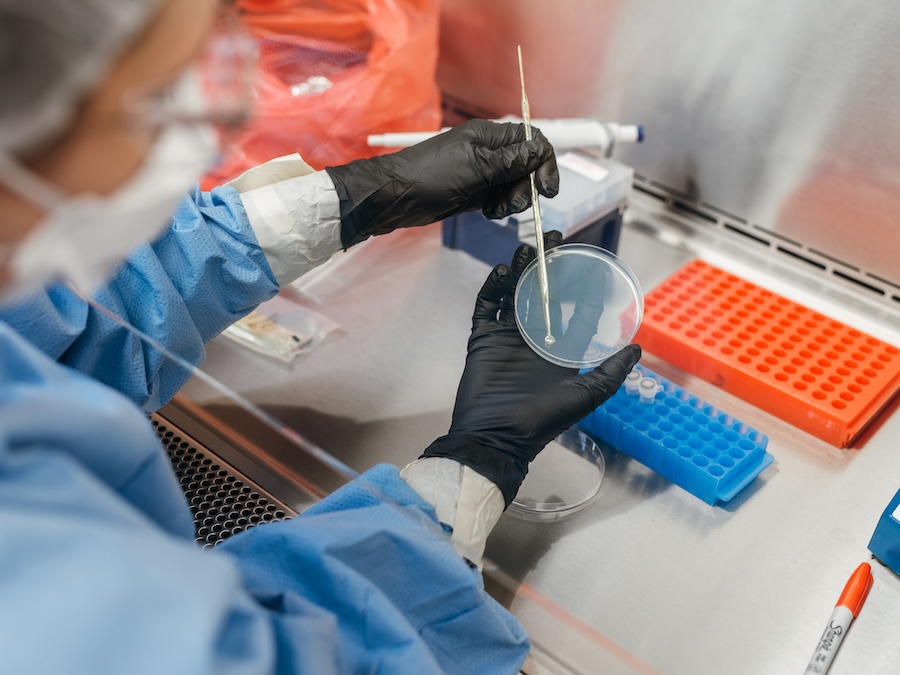
Testing vaccines for partners at Texas Biomed
COVER STORY PART 1 | PART 2 | PART 3
In addition to developing new vaccines, Texas Biomed helps partners to test their vaccines, as well as many other treatments and therapies. The Institute has unique resources and expertise for required testing in cells and animal models, as well as new approach methods (NAMs), such as advanced immunological sequencing, organoids and artificial intelligence-driven modelling. These preclinical studies provide critical insight into how effective a vaccine is, how safe it is, and even what dosage is best to elicit robust protection.
Understanding how an entire immune system reacts to a vaccine is a critical part of safety and efficacy testing and that is why nonhuman primates, as our closest relatives, are the gold standard for evaluating new medicines and vaccines before they are tested in people. They also help provide insights into populations traditionally excluded from clinical trials, notably pregnant people.
Long before a vaccine or medicine is evaluated in large animals, it goes through a robust vetting process in cells in plastic dishes. Those that show the most promise then proceed to small animal models, such as mice, and then finally, nonhuman primates.
Artificial intelligence is being used to help screen for potential compounds that can neutralize pathogens, which helps speed up the initial phases of drug discovery. Efforts are underway to improve other tools, such as organs-on-a-chip, also called organoids, which can indicate how a drug will perform in a specific tissue. However, they are still being developed and refined to incorporate a broad range of cell types. Human immune systems are quite complex and not fully replicated in the organoids yet. At this time, they can help reduce the number of animals needed but cannot completely replace them.
Texas Biomed can also provide advanced immunological sequencing, which shows precisely what antibodies are generated in response to vaccination. These protocols, called BCR-seq and Ig-seq, can be applied to a wide range of vaccines and therapies for chronic illnesses and infectious diseases. For example, Associate Professor Greg Ippolito, Ph.D., who codeveloped the protocols, has used these tools to show the types and effectiveness of antibodies generated by COVID-19 and malaria vaccines.
Texas Biomed is proud to have helped test an array of vaccines, including several that have gone on to help protect millions of people around the world.
Here is a small selection of vaccines tested at Texas Biomed
Hover over or tap each to learn more
Zaire Ebolavirus
Janssen / Johnson & Johnson
Sudan Ebolavirus
Sabin Vaccine Institute
Marburg
Sabin Vaccine Institute
Zika
Walter Reed Army Institute of Research
Status:
Preclinical testing with WRAIR and Trudeau Institute
Read more:
Safe when administered during pregnancyA small selection of vaccines tested at Texas Biomed
| PARTNER | VACCINE TESTED | STATUS | LEARN MORE |
|---|---|---|---|
Pfizer-BioNTech | Covid-19 | FDA Approved | The first approved COVID vaccine |
| Novavax | Covid-19 | FDA Approved | Protein-based vaccine |
| Janssen / Johnson & Johnson | Zaire Ebolavirus | European Commission Approved | Deployed to Democratic Republic of Congo |
| Sabin Vaccine Institute | Marburg | Phase 2 Clinical Trials and Emergency Use in Oct. 2024 | Deployed to Rwanda |
| Sabin Vaccine Institute | Sudan Ebolavirus | Phase 2 Clinical Trials and Emergency Use in Nov. 2022 | Deployed to Uganda |
| Walter Reed Army Institute of Research | Zika | Preclinical testing with WRAIR and Trudeau Institute | Safe when administered during pregnancy |